
I'm Milly, East Africa travel Expert at Go Africa Tours.
As a safari travel planner , some of the most common questions I get are:
“When is the best time to see the Great Migration? Is it better in the Masai Mara or Serengeti / Will I see the River Crossing?”
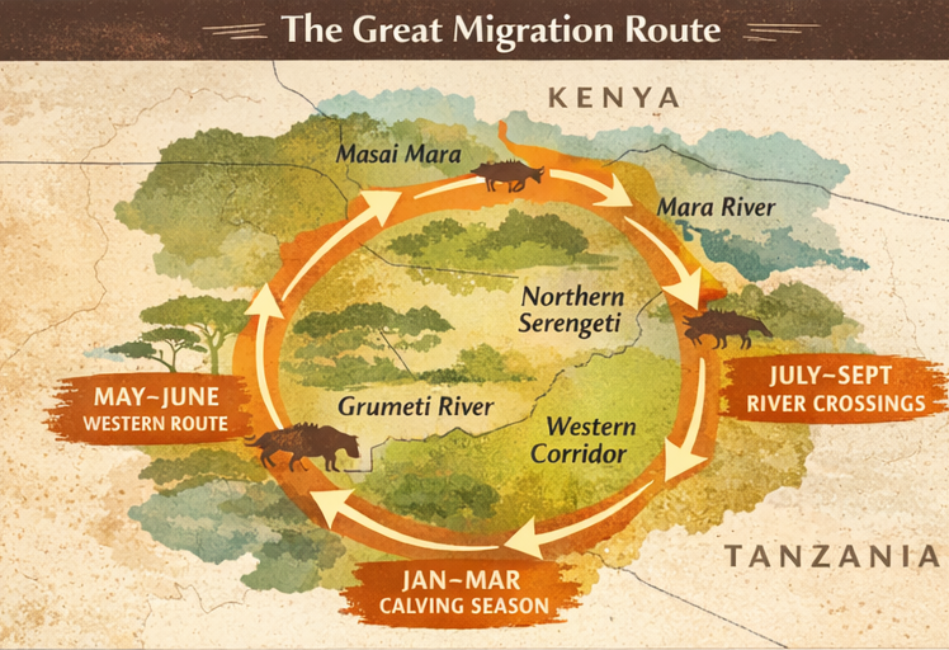
These question deserve nuanced answers. The Great migration is a year-round ecological cycle. Understanding it allows you to design exceptional safaris. If, like me you like digest information better on a chart or table, the below overview is perfect for you. The below table explains this cyle in a nutshell. If you prefer longer, more comprehensive explationation (still have a look at the table), but then proceed further.
The Engine Behind the Migration: Rain, Grass & Survival
-
Migration is driven by rainfall and nutrient-rich grass.
-
Wildebeest track protein, calcium, and phosphorus, essential for lactation and calf survival.
-
Southern Serengeti & Ndutu are calving grounds due to nutrient-rich volcanic soils.
The Great Migration Month by Month
January–February: Calving Season (Southern Serengeti & Ndutu)
-
What’s happening: 500,000 wildebeest calves are born in a 2–3 week window. This synchronized birthing overwhelms predators, increasing survival chances.
-
Remarkable adaptation: Calves are on their feet within 3–7 minutes and walking confidently within 15–30 minutes to evade predators.
-
Predator dynamics: Lions, cheetahs, hyenas, and jackals are active but spread across vast plains, not concentrated at bottlenecks.
-
Bottleneck vs open-plain movement: Calving season has no choke points, making wildlife encounters continuous, immersive, and less crowded.
-
Photography highlights: Open plains, clear sightlines, predator-prey interactions, mother-calf behavior, and dramatic green landscapes.
-
Advisor insight: Fewer vehicles and constant wildlife action make this period ideal for repeat safari travelers, photographers, and those seeking behavior-focused experiences.
March–April: The Transition (Central Serengeti)
-
What’s happening: Herds move north and west following seasonal rains. Plains are lush and green, dotted with kopjes, waterholes, and flowers.
-
Wildlife insight: Herds are dispersed; predators hunt naturally across the plains, creating authentic, ongoing predator-prey interactions.
-
Photography highlights: Expansive green landscapes, frequent predator encounters, dynamic herd movement, perfect for storytelling.
-
Advisor insight: Fewer vehicles, quieter viewing, and passable roads make this an underrated period for mobile safaris.
-
Best for: Photographers, repeat safari travelers, and clients who want migration in motion rather than a single spectacle.
May–June: Western Corridor & Grumeti River
-
What’s happening: Herds funnel into the Western Corridor. Early Grumeti River crossings occur at scattered tributaries and pools, smaller and less dramatic than Mara crossings.
-
Wildlife insight: Predators track herds along the corridor, creating intimate predator-prey encounters without crowds. Crocodiles are present, but crossings are moderate and educational.
-
Important distinction:
-
Less predictable: Herds may wait or cross multiple times
-
Less crowded: Few vehicles compared to Mara peak
-
More immersive: Guests can observe mother-calf interactions and herd dynamics up close
-
-
Photography highlights: Small herd clusters, dynamic predator interactions, dramatic light on Western Corridor plains.
-
Advisor insight: Ideal for travelers seeking exclusive, immersive experiences; early rains make road access and guide expertise important.
-
Best for: Seasoned safari travelers and repeat clients seeking privacy and high-quality wildlife observation.
May–June: Northern Serengeti–Masai Mara Ecosystem
-
What’s happening: Herds enter the Northern Serengeti–Mara ecosystem, testing riverbanks and tributaries, previewing the iconic Mara River crossings.
-
Wildlife insight: Predators follow herds, but smaller, scattered crossings allow intimate, authentic wildlife viewing without large crowds. Crocodiles are present but crossings are moderate.
-
Important distinction:
-
Less predictable: Herds pause or cross in small groups
-
Less crowded: More private than Mara peak
-
More immersive: Observe mother-calf interactions, herd movement, and predator strategy
-
-
Photography highlights: Early crossing action, predator-prey interactions, expansive plains with dramatic lighting.
-
Advisor insight: Multi-night stays here dramatically increase the chance of witnessing migration and allow clients to track herd movement over several days.
-
Best for: Seasoned safari travelers, repeat clients, and those seeking privacy and early-season Mara River previews.
July–September: Mara River Peak & Northern Serengeti
-
What’s happening: Dry season peaks; herds concentrate near permanent water sources. Mara River crossings occur but remain unpredictable. Northern Serengeti offers extended herd presence before and after crossings.
-
Critical advisor reality check:
-
River crossings are not daily or guaranteed
-
Camps cannot control timing; patience is required
-
Crowds are higher at prime crossing points, but planning reduces congestion
-
-
Masai Mara vs Northern Serengeti:
-
Masai Mara: Iconic crossings, higher herd and vehicle density
-
Northern Serengeti: Fewer vehicles, longer herd presence, quieter viewing
-
-
Advisor insight: Multi-night stays in the Mara maximize sightings, allow tracking herd movement, and create flexibility for photography and observation.
-
Photography highlights: Dust clouds, predator-prey action, herd panoramas, dramatic morning/evening light.
-
Best for: First-time migration viewers, photographers seeking dramatic action, and clients who want classic Mara River moments.
October–November: Southbound Return
-
What’s happening: Herds begin moving south into Northern Serengeti; occasional late crossings occur. Predator activity and dramatic light make this ideal for photography.
-
Advisor insight: Fewer crowds, softer light, and expansive plains offer immersive safari experiences for clients who value atmosphere over spectacle.
December: The Cycle Resets
-
What’s happening: Short rains pull the herds south toward Ndutu, completing the annual cycle.
Managing Expectations around River Crossings - It's highly likely but not guaranteed
-
Many travel agent guarantee river crossing, I opt not to: It depends on herd pressure, water levels, predator presence, and weather
-
Herds normally cross during the day, but they may hesitate & turn back, or even cross at night